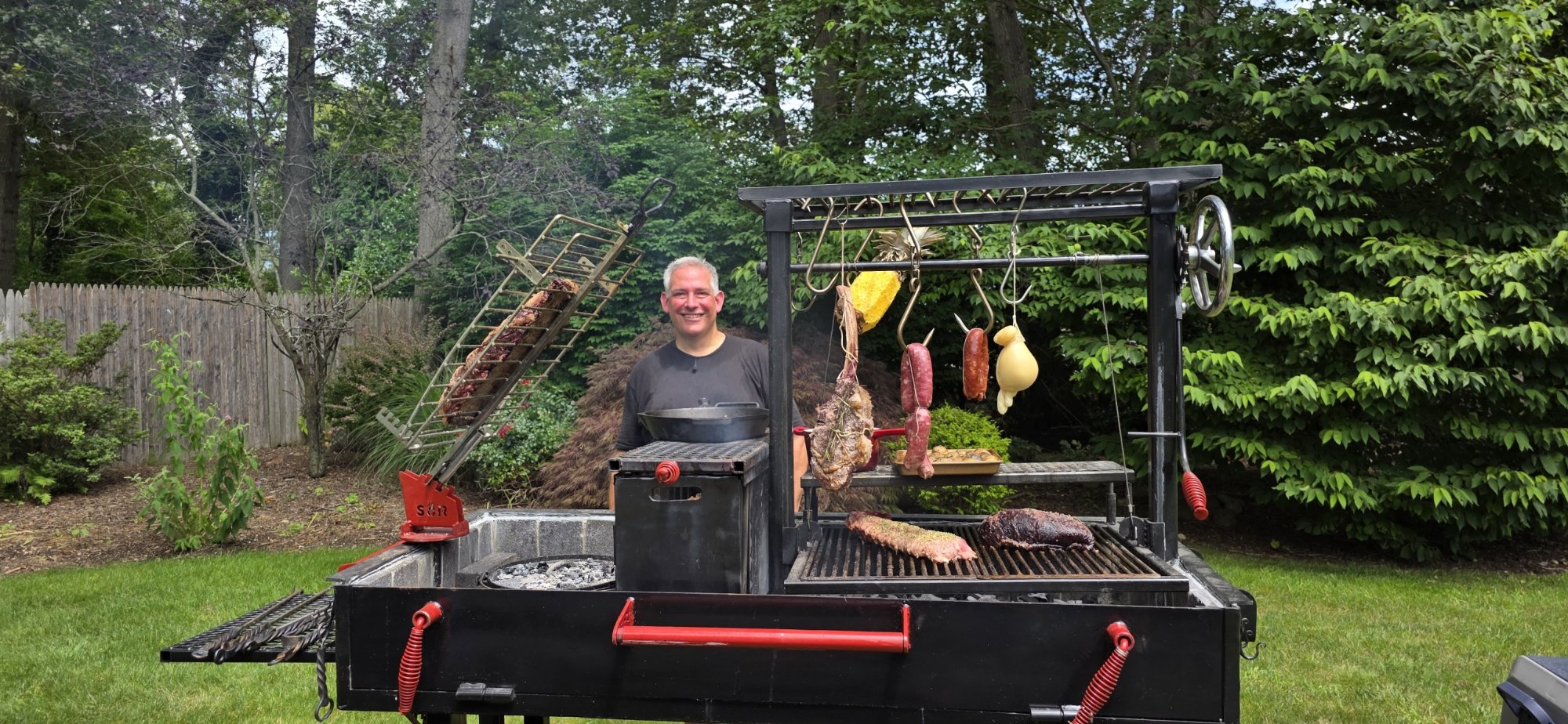
The extra steel from my smoker build became my first Santa Maria grill. I wanted to get into live fire cooking. Did my research. Built it. Got it completely wrong.
Here is what most people miss about the difference between a Santa Maria grill and an Argentine parrilla, and why it took building two of them before I finally understood what I was actually trying to cook on.
Here is what actually separates these two cooking systems, and why the difference matters more than most people realize.
A Santa Maria grill cooks over live wood flame. You build a fire directly beneath the grate, you crank the grate up or down based on how much heat you want, and you cook. It is direct, aggressive, and produces incredible searing and smokiness from the fat hitting the fire.
An Argentine parrilla does something fundamentally different. You never cook over live flame. You build your fire in a separate brasero firebox off to the side, let the wood burn down to coals, then shovel those coals beneath the cooking grate. You are cooking over the heat that the fire leaves behind, not the fire itself.
The brasero firebox is the heart of the Argentine parrilla system. It lets you produce a continuous supply of embers throughout a long cook without disturbing the cooking surface. You tend the fire in the brasero, burn wood down to coals, and introduce those coals under the grate as needed.
The result is total heat control without touching the food or disrupting the cook. You want more heat? Add coals. You want less? Rake some back. The grate height adjustment gives you a second dimension of control, distance from the embers, on top of the ember volume control.
On a standard Santa Maria grill, you manage heat by cranking the grate. That is one axis of control. On an Argentine parrilla with a brasero, you have two independent axes, grate height and ember volume. For long, complex cooks with multiple proteins at different stages, that dual control is the difference between guesswork and mastery.
I built my first Santa Maria in 12-gauge steel. It cooked fine for the first season. By the second season, the firebox had warped, the floor of the cook surface was no longer flat, and the whole structure had lost its rigidity.
The problem is thermal cycling. Steel expands when hot and contracts when cool. Thin steel, 12-gauge, 3/16", cannot handle thousands of those cycles without losing its shape. 1/4" heavy plate carbon steel is a different category entirely. The thermal mass is greater, the expansion and contraction is more controlled, and the structure maintains its geometry across decades of use.
Every Brasero Grills build uses 1/4" heavy plate throughout. Not just the firebox, the entire structure. When you stand next to one, you feel the difference before you even light it.
Here is something nobody in the Santa Maria or Argentine parrilla market talks about: food contact surface standards. Every grate that comes in contact with your food is a food contact surface. In a commercial kitchen, that surface must use a high-heat food-contact coating, no materials that can flake, leach, or off-gas at cooking temperatures.
Standard grill grates are bare steel, painted steel, or basic powder coat, none of which meet commercial food safety standards. Brasero Grills runs pre-seasoned solid-rod steel cooking grates, and the iron cross carries a high-heat food-contact coating. No flaking. No off-gassing. No compromise on what your food touches.
It is the standard we came from in professional kitchens. It should be the standard everywhere.
After building both systems and cooking on both extensively, I made a decision: build both into one platform. Keep the Santa Maria crank wheel system for its precision height control and live flame capability. Add the Argentine brasero firebox for ember management and slow cooking. Firebrick lines the cooking chamber for thermal mass. Run pre-seasoned solid-rod steel cooking grates and apply the high-heat food-contact coating to the iron cross.
The result is a grill that can cook Santa Maria style over live flame, Argentine asado style over embers, or any combination of both in the same session. You don't choose a technique. You have all of them.
That is the Forge Collection. See the full lineup here.
Every Brasero is commissioned directly. Limited Q2 2026 availability remaining.
Commission Your Build